
 1935 was a big year in the industry of animated cartoons. Everybody except Paul Terry (who was busy cleaning copper stains off his thumb and forefinger) was showing an interest in making color cartoons. Walt Disney had stolen a march on his competitors by getting an exclusive on the three-strip Technicolor process until December 31st, 1935. He was thus able to back up his storytelling skills with a brilliant palette. Max Fleischer was no different than Ub Iwerks, Van Buren, Walter Lantz, or Charles Mintz – he wanted to get into color cartoons as well. After doing one cartoon in the red and cyan Cinecolor process, he decided to switch over to the two-strip Technicolor process. As there were no Screen Songs in the 1934-35 season, all the energy that would have gone into those was re-directed and channeled into the “Color Classics” series. The series strove for the Disney-esque (which was not necessarily Fleischer’s forte), and frequently featured original songs by staff songwriters, some of which were quite memorable in their own right.
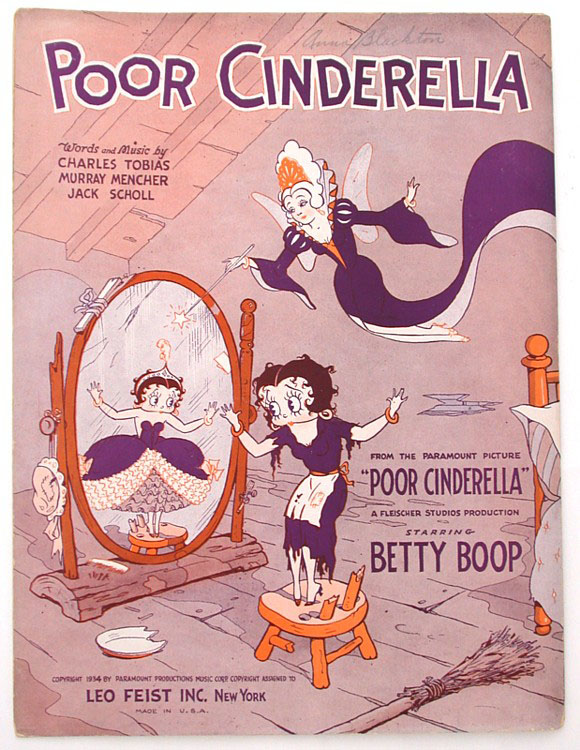 Poor Cinderella (8/3/34) – Who knew that Betty Boop was a redhead? This jarring truth is vividly revealed by a choice of hues that leaves her hair resembling a pumpkin pie filling. (Not at all accurate to the range of shading evident on any black-and-white episode, as black and white TV prints of this extended color production make her hair look gray instead of black.) Plotwise, the film adheres somewhat closely to the standard tropes of the classic story, avoiding broader off-the-wall humor that would predominate rival productions by Warner Brothers and the like. All the usual elements are there: bickering stepsisters, glass slippers, fairy godmother, – you name it. One of the few departures is the giving of a personality to the pumpkin for the coach, as a jack-o-lantern, who would rather become a mobile vehicle than a stack of pumpkin pies. In one of the only pre-code gags of the film, Betty loses most of her attire during the transformation to her ball gown, stripped down to her petticoats, with the godmother supplying her with the trademark garter before materializing the dress. Was this the first use of the “turntable camera” dimensional effects that would liven up so many of Max’s later cartoons? The invention, adding model set backgrounds in rotating dimension behind the animation, is used to full visual; effect in the coach ride sequences, and to a more limited degree in the ballroom dance (though characters within the ballroom maintain a very flat look). The ending is a bit anticlimactic, coming up with no plot twists to get the slipper fitted on Boop’s petite toes. The film features two original numbers, “Pretty Cinderella”, sung by the fairy godmother, singing mice, lizards, and the pumpkin, and “Poor Cinderella,” sing by Boop and featured as music at the ball (with vocal by a caricature of recurring Fleischer veteran Rudy Vallee). Both numbers were composed by Charlie Tobias, Jack Scholl, and Sammy Timberg – neither was commercially recorded.
Little Dutch Mill (10/26/34) – Two Dutch kids in their little wooden shoes are
frolicking amoung the tulips and windmills. They spot an ill-tempered, disreputable-looking man, and follow him home, spotting him through the window fondling a hoard of gold coins. The miser does not like to be spied upon. That evening, the kids’ wooden shoes do not appear on the doorstep of their home as with the other children, and the community wonders what has become of them. The miser has captured the children, and threatens to burn their tongues out with a hot iron to keep them from telling about his gold. The kids’ pet duck gets away and warns the populace, who storm the miser’s mill. Notably, the townsfolk do not choose to do away with the miser or take him in, but decide to reform him by “cleaning up” his act – with buckets of soap and water, hair clippers and new clothes, transforming the mill and the miser into spit and polish neatness until they glisten and shine. The transformation is particularly striking upon the miser, whose voice rises from gravelly baritone to near-tenor, and who develops a whole new outlook of generosity and wanting to interact with his fellow man. Song: “Little Dutch Mill”, a tin pan alley song from 1934, fairly widely covered. For dancing, Don Bestor got it for Victor, Guy Lombardo on Brunswick (who would re-record the identical arrangement for a Decca four album retrospective on Guy’s career in the 1950’s), Al Mitchell (pseudonym for Sid Peltyn) on Bluebird, and Chick Bullock and his Levee Loungers on Melotone, Perfect, et al. Brunswick also had a popular vocal version by Bing Crosby. British versions included Ray Noble on HMV with vocal by Al Bowlly, Lew Stone for Decca, and Henry Hall for Columbia. The tune even found its way into a 1950’s kiddy-record release (retitled “The Little Dutch Boy ad the Little Dutch Girl”) on Peter Pan records.
An Elephant Never Forgets (12/28/34) – Hijinks in a jungle school, with the animal kids happily heading for class with a musical sing-song, seeming to be really enjoying themselves (an unusual attitude indeed for kids of the time). Perhaps their attitude may be best explained by what follows, as the classroom erupts in a total free for all whenever the teacher’s back is turned. The largest student (an elephant) is bullied by an ape, who smashes a washboard over his head. This eventually leads to every kid in the class throwing every object not ailed down at each other, until the teacher returns, and they put the brakes on the fight. Despite the room being in shambles, the teacher is satisfied merely at the class being quiet, and sends them home without punishment. The elephant, who has insisted he never forgets throughout the picture, gets final revenge on the ape, by placing the ape’s washboard in the seat of his trousers, to absorb blow of the ape’s swift kick, and smash his toes but good at the same time. Two more original tunes underscore the film, “We’re On Our Way To School Today”, and “An Elephant Never Forgets”, both written by Jack Scholl and Sammy Timberg, again with no commercial recordings.
Song of the Birds (3/1/35) – A little boy, playing with firearms, goes out and shoots down a bird. Realizing what he has done, he is all sad and morose, as the birds perform the ceremony of a woodland funeral – until the boy’s prayers are answered by a rain shower, which revives the little bird, only stunned and still very much alive. The boy throws away firearms forever, and feeds his new forest friends instead of firing upon them. The film was remade under the same title as a Little Audrey episode in 1949. A title number is instrumentally presented, composed by Sammy Timberg, and again not commercially recorded.
The Kids in the Shoe (5/19/35) – The woman in the shoe has the usual problems with so many mouths to feed, and so many kids to keep in line. When the kids cheat on washing up for dinner, they get sent to bed with orders to go right to sleep – and no music. This leads to a rebellious riot, with pillows flying and bedroom fixtures converted into musical instruments (predicting a later effort from Famous Studios for the Popeye series, “Me Musical Nephews”). Mama is awakened, and forced to break out the castor oil, causing the kids to cease fire and drop off to sleep immediately. The bottle, however, turns out to be a subterfuge, with a false label that conceals a bottle of sweet cider for Mama. The featured song is ‘Mama Don’t Allow It” (aka “Mama Don’t Like Music”), a ditty written by Cow Cow Davenport. The version used in the film is a needle drop by Smilie Burnette on Melotone, Perfect, et al. Julia Lee and her Boy Friends released am early 50’s version with some jazz cats, including Benny Carter and Red Norvo, on Capitol. A 50’s Columbia issue was released by a dixieland group called the Cell Block 7. Frankie Lymon recorded an updated version for Roulette. An interesting late television version exists with Roy Acuff, and a rather out of place duet version by Bing Crosby and Jose Feliciano.
 Dancing on the Moon (7/12/35) – Honeymooning gets a new twist, with a rocket ride to the moon for only $1.00. Newlyweds of various species board, but a pair of cats are late, and only the male manages to get aboard, with the wife is left at the post. She assumes he will be up to no good all alone, and calls him an “alley cat” Instead, the tom is left alone and totally bored, taking solace in a game of solitaire, while the remaining couples enjoy themselves immensely in dancing amidst the moon’s craters, and romancing in a lovers lane. (The giraffes comment that “This is a great place for necking”.) When the rocket returns to earth, a line of storks are waiting to deliver each couple their new arrivals. But since the missus missed the flight, the cats wind up empty handed, and the missus clobbers her tom for all his troubles. The title song is a memorable and engaging original by Charlie Tobias and Murray Mencher, never commercially recorded – bit it should have been. Other returning favorites include “When the Moon Comes Over the Mountain”, and “By the Light Of the Silvery Moon”.
Time For Love (9/14/35) – Two white swans are necking in a lake in the park. They are met by a black swan, who immediately cuts himself in, and demonstrates his skill at fishing. This leaves the male white swan disconsolate, as he can’t get the hang of it. The black swan proves a villain, eventually forcing the female to do all his fishing for him, but ultimately receives his come-uppance as the white male comes to the rescue. “Love in Bloom” provides the primary theme behind the action, a song from the motion picture, “She Loves Me Not”. Recorded as a vocal by Bing Crosby (who introduced it in the film) on Brunswick, and by Georgie Price on Melotone, Perfect et al., and as a dance record by Paul Whiteman on Victor, Ernie Holst and his Central Park Casino Orchestra on Bluebird and Montgomery Ward, and Hal Kemp on Brunswick. The song would of course become indelibly connected with Jack Benny as his de-facto theme song. Later, the piece was given “the treatment” by Spike Jones and his City Slickers on Victor. There is also an aircheck (embed below) from a Bing Crosby show which provides the rare opportunity to hear the song’s originator collaborate with the Spike Jones orchestra in their uproarious sendup. The song was also performed as an album cut by the Platters on Mercury, who spent much of the 1950’s raiding the Great American Songbook.
Musical Memories (11/9/35) – No plot to speak of. Miscellaneous nostalgic vignettes are visualized through the photos of a stereopticon in the collection of an elderly couple. The primary strength of the film is in its use of third-dimensional sets for the turntable camera, ranging from Bowery to ballroom. “Love’s Old Sweet Song”, “When You and I Were Young, Maggie”, “The Sidewalks of New York”, “The Bowery”, “Little Annie Rooney”, “In the Good Old Summertime”, “Daisy Bell”, “After the Ball”, “On a Sunday Afternoon”, “Put On Your Old Gray Bonnet”, and “Silver Threads Among The Gold”, all visited before, receive reuse.
Next Time: Betty Boop 1934-35.